

Excerpt Why January 2022

https://sloanreview.mit.edu/article/toxic-culture-is-driving-the-great-resignation/

  • To better understand the sources of the Great Resignation and help leaders respond effectively, we analyzed 34 million online employee profiles to identify U.S. workers who left their employer for any reason (including quitting, retiring, or being laid off) between April and September 2021. The data, from Revelio Labs, where one of us (Ben) is the CEO, enabled us to estimate company-level attrition rates for the Culture 500, a sample of large, mainly for-profit companies that together employ nearly one-quarter of the private-sector workforce in the United States.
  • Top Predictors of Attrition During the Great Resignation
    The authors analyzed the impact of more than 170 cultural topics on employee attrition in Culture 500 companies from April through September 2021. These five topics were the leading predictors of attrition. Each bar indicates the level of importance of each topic for attrition relative to employee compensation. A toxic culture is 10.4 times more likely to contribute to attrition than compensation.

    Toxic corporate culture

    10.4

    Job Security and Reorganization

    3.5

    High level of innovation

    3.2

    Failure to reorganize employee performance

    2.9

    Poor response to COVID-19

    1.8

    Importance relative to compensation

  • Toxic corporate culture. A toxic corporate culture is by far the strongest predictor of industry-adjusted attrition and is 10 times more important than compensation in predicting turnover. Our analysis found that the leading elements contributing to toxic cultures Include failure to promote diversity, equity, and inclusion; workers feeling disrespected; and unethical behavior.

Excerpt Why March 2022

https://sloanreview.mit.edu/article/why-every-leader-needs-to-worry-about-toxic-culture/

  • Employee turnover triggered by a toxic culture cost U.S. employers nearly $50 billion per year before the Great Resignation began.
    To understand what makes a culture toxic, we analyzed the language employees use to describe their organization. When workers write a Glassdoor review, they rate corporate culture on a 5-point scale and also describe their employer’s pros and cons. The topics they choose to write about reveal which factors are most relevant to them. By analyzing the relationship between how they describe their employer and how they rate its culture, we were able to shed light on the cultural factors that best predict a toxic culture. We studied more than 1.3 million Glassdoor reviews from U.S. employees of Culture 500 companies, a sample of large organizations from 40 industries.
  • We used the text analytics platform developed by CultureX to identify which topics each employee discussed negatively. (We measured 128 topics in total.) We then analyzed which of the topics mentioned had the largest negative impact on how employees rated corporate culture on a 5-point scale.
    Disrespectful
    Lack of consideration, courtesy and dignity for other 66
    No Inclusive
    LGBTQ inequity 65
    Disability inequity 55
    Racial inequity 58
    Age inequity 44
    Gender inequity 40
    Cronyism and nepotism 40
    General no inclusive culture 33
    Unethical
    Unethical behavior 62
    Dishonesty 59
    Lack of regulatory complince 44
    Cutthroat
    Backstabbing behavior and ruthless competiton 61
    Abusive
    Bullying, harassment, and hostility 50
  • ( MIT SMR/Glassdoor Culture 500, is an annual index and research project that uses over 1.4 million employee reviews to analyze culture in leading companies)

Excerpt Why November 2015

https://www.hbs.edu/faculty/Publication%20Files/16-057_d45c0b4f-fa19-49de-8f1b-4b12fe054fea.pdf

ABSTRACT

“While there has been a strong focus in past research on discovering and developing top performers in the workplace, less attention has paid to the question of how to manage the workers on the opposite side of the spectrum: Those who are harmful to organizational performance. In extreme cases, aside from hurting performance, such workers can generate enormous regulatory and legal and liabilities for the firm.

We explore a large novel dataset of over 50,000 workers across 11 different firms to document a variety of aspects of workers' characteristics and circumstances that lead them to engage in what we call “toxic” behavior.

We also explore the relationship between toxicity and productivity, and the ripple effect that a toxic worker has on her peers.

Finally, we find that avoiding a toxic worker (or converting him to an average worker) enhances performance to a much greater extent than replacing an average worker with a superstar worker.”

Excerpt Why May - June 2020

https://hbr.org/2020/05/why-sexual-harassment-programs-backfire

Neither the training programs that most companies put all workers through nor the grievance procedures that they have implemented are helping to solve the problem of sexual harassment in the workplace. In fact, both tend to increase worker disaffection and turnover.

Research shows that harassment training makes men more likely to blame the victims.

Bystander-intervention training is the most promising alternative we’ve come across. Sharyn Potter and her team at the University of New Hampshire’s Prevention Innovation Research Center have long conducted interesting experiments with it on college campuses and military bases, where harassment and assault are rampant. A dozen years ago they piloted a college bystander-intervention program that has since been used on more than 300 campuses. In 2011 it was adapted for the U.S.

The figure — and the numbers — tell a clear story. From 2009 to 2019, the average monthly quit rate increased by 0.10 percentage points each year.

Excerpt Why March 2022

https://hbr.org/2022/03/the-great-resignation-didnt-start-with-the-pandemic

The numbers are sobering.
In 2021, according to the U.S. Bureau of Labor Statistics, over 47 million Americans voluntarily quit their jobs — an unprecedented mass exit from the workforce, spurred on by Covid-19, that is now widely being called the Great Resignation. Worker shortages are apparent everywhere: Gas stations and dentists offices alike have reduced their hours of operation because they can’t find new employees to replace those who have quit. The Great Resignation, we’re told, has upended the relationship between workers and the labor market.
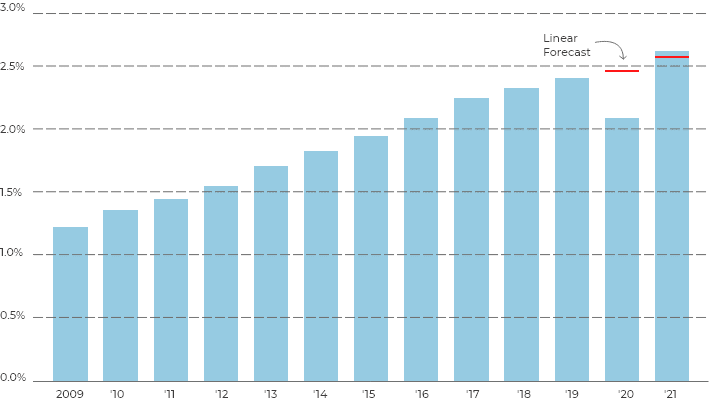
But such talk is overblown. A record number of workers did quit their jobs in 2021, it’s true. However, if you consider that number in the context of total employment during the past dozen years, as illustrated in Figure 1, you can see that what we are living through is not just short-term turbulence provoked by the pandemic but rather the continuation of a long-term trend.

Data on total employment from 2009 through 2019 reveals that the Great Resignation is not a pandemic- diven anomaly.

Share of workers voluntarily leaving jobs
Graph

The figure — and the numbers — tell a clear story. From 2009 to 2019, the average monthly quit rate increased by 0.10 percentage points each year.

Excerpt Why May 2022

https://www.cnbc.com/2022/05/24/great-resignation-to-continue-one-in-five-likely-to-switch-jobs- pwc.html

The Great Resignation is set to continue, according to a new global survey by PwC, with one in five saying they are likely to switch jobs in the next 12 months.
PwC launched its “Global Workforce Hopes and Fears Survey 2022” at the World Economic Forum in Davos on Tuesday, which surveyed more than 52,000 workers in 44 countries.

  • Job fulfilment ‘just as important’
    More money is the biggest motivator for a job change, yet finding fulfillment at work is “just as important,” according to PwC.
  • Workers want a workplace that allows them to truly be themselves too, with 66% of those surveyed indicating this as an important factor.

Excerpt Why

https://workplacebullying.org/wp-content/uploads/2021/04/2021-Full-Report.pdf 
  • Toxicity in US companies
    • 29,5% of US workforce bullied at work (48.6 million)
    • 65% bullies are bosses (higher ranked)
    • 43.2% bullied while remote working
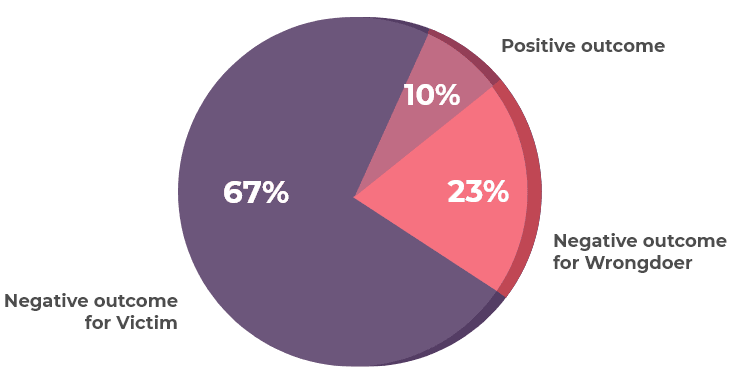
  • Negative outcome mostly for victim
    • 67% negative outcome for victim (left, forced to quit, terminated, transferred)
    • 23% negative outcome for victim for wrongoer (punishment, termination, quitting)
Why
Why
  Proportion Percentage
Target voluntarily left the job to escape more mistrearmwent 2346 23%
Target was forced to quit when work conditions were deliberately made interable 1732 17%
Employer terminated the target 1181 12%
Target transferred to different job or location with same employer 1496 15%
Negative outcome for target 6755 67%
Perpetrator was punished but kept job 1055 11%
Perpetrator was terminated 0897 9%
Perpetrator voluntarily quit 0346 3%
Negative outcome for perpetrator 2298 23%
Positive actions by employer stopped it 0582 6%
Positive actions target's coworkers stopped it 0362 4%
     
It did not stop 1229 12%

Excerpt Why

https://fortune.com/2022/01/25/why-managers-are-quitting-during-the-great-resignation/

  • Humu, an automated software platform that coaches managers on performance-driving work habits, surveyed 200 managers, 200 HR leaders, and analyzed data from 90,000 employees for its “State of the Manager Report,” released Tuesday. It found that being the boss is more challenging and less rewarding now than it’s ever been. It requires appealing to the mounting needs and demands of workers as well as satisfying the higher-ups, leaving folks in middle management with minimal time for their own advancement.
  • Additionally, Humu found, hybrid work isn’t cutting it. Seven in 10 hybrid employees said they felt disconnected from their coworkers, and two in three felt left out when they’re not working in the office, according to HR Dive. Managers of hybrid employees have to go the extra mile to keep teams connected and aligned — and to combat biases, as they are prone to “on-site favoritism,” doling out more opportunities to the workers they see face-to-face, Humu reported. Managers can be an organization’s superpower or its Achilles heel, Humu CEO Laszlo Bock tells Fortune. “The rate of managers leaving is doubling. Suddenly you have an entire generation of leadership that’s just gone away; that’s potentially devastating.”

Excerpt Why

https://pmq.shrm.org/wp-content/uploads/2020/07/SHRM-Culture-Report_2019-1.pdf

  • 38%Of American workers are 'very satisfied with their current job.
  • 49%Have thought about leaving their current organization.
  • 1/5Have left a job due to workplace culture.
  • 58%Of Those who left a job to culture claim people managers are the main the reason they ultimately left.
  • 25%Of Americans define organizational culture as a combination of employees' attitudes, actions and behaviors.
  • 76%Say their manager set the culture of their workplace.
  • 36%Say their manager doesn't know how to lead a team.
  • 1/4Dred going to work.
    Don't feel safe voicing their opinions about work-related issues.
    Don't feel respected and valued at work.
  • 4/10Say their manager fails to frequently engage in honest conversations about work topics
  • $ 223BIs the cost of turnover due to workplace culture over the past 5 years.

Excerpt Why May 27, 2022

https://www.mckinsey.com/mhi/our-insights/addressing-employee-burnout-are-you-solving-the-right-problem

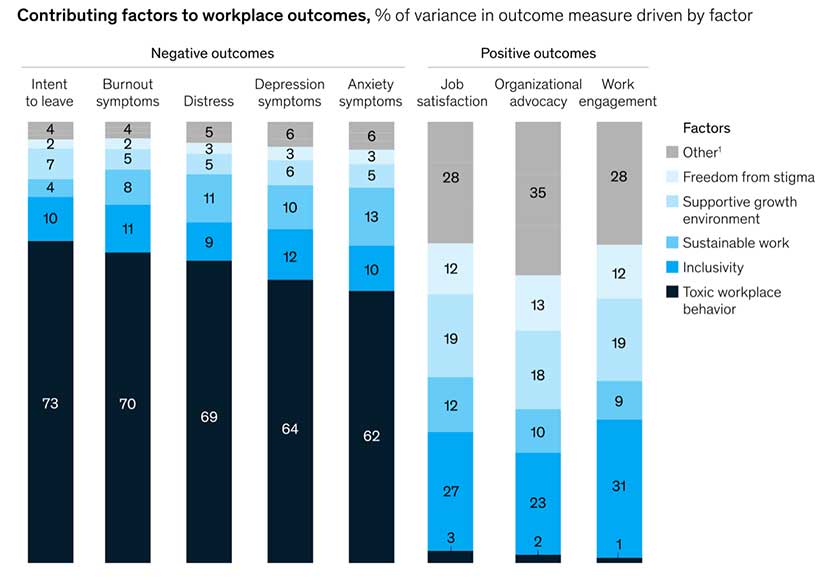
  • To better understand the disconnection between employer efforts and rising employee mental-health and well-being challenges (something we have observed since the start of the pandemic), between February and April 2022 we conducted a global survey of nearly 15,000 employees and 1,000 HR decision makers in 15 countries.
  • In all 15 countries and across all dimensions assessed, toxic workplace behavior was the biggest predictor of burnout symptoms and intent to leave by a large margin24—predicting more than 60 percent of the total global variance. contribution factors